Lawvere's Theorem: Generalizing Cantor, Russell, Turing, Tarski, and Gödel
27 Oct 2026
Mathematics
Category Theory
Logic
Students of mathematical logic would have at some point noticed that Cantor’s proof of the uncountability of the reals, Russell’s set-theoretic paradox, Turing’s halting problem, Gödel’s incompleteness theorem, and Tarski’s undefinability theorem all share a similarity. They all employ a diagonal argument, whereby one “feeds” an argument to itself. This similarity can be formulated precisely in the language of category theory.
Lawvere’s Theorem
Definition. A category $\mathcal{C}$ is Cartesian closed if it satisfies the following.
$\mathcal{C}$ has a terminal object $1$.
$\mathcal{C}$ admits arbitrary products of finitely many objects.
For every $B \in \mathcal{C}$, $(-) \times B : \mathcal{C} \to \mathcal{C}$ has a right adjoint.
We call the right adjoint of $(-) \times B$ the exponential and denote $(-)^B$. Thus,
\[\hom(A \times B, C) \cong \hom(A, C^B)\]
naturally in $A, B, C$. Thus Cartesian closed category is a generalization of currying. Until further notice, we assume that $\mathcal{C}$ is Cartesian closed.
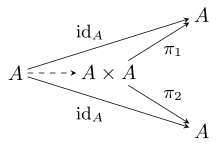
Definition. The diagonalization $\Delta_A$ of $A \in \mathcal{C}$ is the unique map induced by the following diagram:
Definition. A point of $X \in \mathcal{C}$ is a morphism $1 \to X$.
Note that a point is a category-theoretic generalization of an element of a set. For example, in $\mathbf{Set}$, $\Delta_A: A \to A \times A$ is the map $a \mapsto (a, a)$.
We can thus generalize the notion of surjectivity.
Definition. $f: X \to Y$ is point surjective if for every point $y \in Y$, there exists a point $x \in X$ such that $f\circ x = y$.
I will also write $f(x) = y$ in place of $f \circ x = y$.
The following gives a category-theoretic generalization of the diagonal argument.
Lawvere’s Theorem. Let $\mathcal{C}$ be a Cartesian closed category. If $f: A \to B^A$ is point surjective, for every $g: B \to B$, there exists a point $b$ of $B$ such that $g(b) = b$.
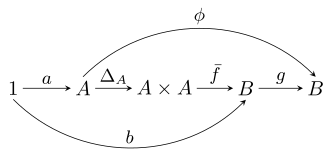
Proof. Let $\bar{f} : A \times A \to B$ be the adjoint of $f$. Define $\phi: A \to B$ as $g \circ \bar{f} \circ \Delta_A$.
Since
\[\hom(A, B) \cong \hom(1 \times A, B) \cong \hom(1, B^A),\]
let $\bar{\phi} : 1 \to B^A$ be the adjoint of $\phi$. By point surjectivity of $f$, there exists a point $a: 1 \to A$ such that $f(a) = \bar{\phi}$. By naturality of the adjunction, we have the following commutative diagram.
\[\begin{CD}
\hom(1\times A,\, B) @>{\overline{(-)}}>{\cong}> \hom(1,\, B^A) \\
@A{(-)\circ(a\,\times\,\mathrm{id}_A)}AA @AA{(-)\circ a}A \\
\hom(A\times A,\, B) @>{\cong}>{\overline{(-)}}> \hom(A,\, B^A)
\end{CD}\]
Chasing $\bar f$ around the square, and identifying $1 \times A$ with $A$ (under which $a \times \mathrm{id}_A$ becomes $\langle a \circ \operatorname{!}_A, \mathrm{id}_A \rangle : A \to A \times A$), we obtain
\[\bar{f} \circ \langle a \circ \operatorname{!}_A, \mathrm{id}_A \rangle = \phi\]
Hence, since $\langle a \circ \operatorname{!}_A, \mathrm{id}_A \rangle \circ a = \langle a, a \rangle = \Delta_A \circ a$,
\[\begin{align}
\bar{f} \circ \langle a \circ \operatorname{!}_A, \mathrm{id}_A \rangle \circ a &= \bar{f} \circ \Delta_A \circ a \\
&= \phi \circ a
\end{align}\]
Let $b := \bar f \circ \Delta_A \circ a$. The following diagram then commutes.
In particular, $g(b) = g \circ \bar f \circ \Delta_A \circ a = \phi(a) = \bar f \circ \Delta_A \circ a = b$. ■
Cantor and Russell
Corollary (Cantor). In $\mathbf{Set}$, there is no (point) surjective map $f: A \to 2^A$.
Proof. Assume otherwise. Then by Lawvere’s theorem, every map $2 \to 2$ has a fixed point. However, $0 \mapsto 1, 1 \mapsto 0$ does not have a fixed point. ■
Corollary (Russell). The axiom of naive comprehension is inconsistent.
Proof. Assume naive comprehension, and suppose the sets it produces form a Cartesian closed category as in $\mathbf{Set}$. Then $\phi(x): x = x$ defines the set of all sets $S$, and $2^S$ is the set of all propositions over $S$. Consider
\[f : S \to 2^S, \qquad x \mapsto (y \mapsto [y \in x]).\]
By naive comprehension, every $P \in 2^S$ determines a set ${y : P(y)}$, so $f$ is (point) surjective. This contradicts Lawvere’s theorem, with $0 \mapsto 1, 1 \mapsto 0$. (Unwinding the proof, the point $a$ is the set ${x : x \notin x}$.) ■
Weak point-surjectivity
Let $\mathcal{C}_{\mathsf{PA}}$ be the category of decidable sets, i.e.
Objects: Decidable subsets of $\mathbb{N}$ modulo PA-provable equivalence.
Morphisms: Functions that PA proves to be total (modulo PA-provable equality).
Then $1 = {0}$ is the terminal object, and
\[\begin{gather}
A \times B = \{ \langle a, b \rangle : a \in A, b \in B \} \\
\pi_1 : \langle a, b \rangle \mapsto a, \quad \pi_2 : \langle a, b \rangle \mapsto b
\end{gather}\]
is the product, where $\langle \cdot, \cdot \rangle$ is the code for a pair.
We prove the following lemma:
Lemma. Assuming $\mathsf{PA}$ is consistent, $\mathcal{C}_\mathsf{PA}$ is not Cartesian closed.
Proof of the lemma. Assume otherwise. Then a point of $2^\mathbb{N}$ is adjoint to a provably total function $\mathbb{N} \to 2$. In particular, $2^\mathbb{N}$ has a point $e_0$, adjoint to the constant function $0$. Since $2^\mathbb{N}$ is an object of $\mathcal{C}_\mathsf{PA}$, it is a decidable subset $E \subseteq \mathbb{N}$, with inclusion $i : E \to \mathbb{N}$.
Define $\Theta: \mathbb{N} \to 2^\mathbb{N}$ such that
\[\Theta(n) = \begin{cases}
n &n \in E \\
e_0 &\text{otherwise}
\end{cases}\]
Then $\Theta$ is a morphism (i.e. provably total, since $E$ is decidable), and $\Theta \circ i = \mathrm{id}_E$. Hence for every point $p$ of $2^\mathbb{N}$, $\Theta(i \circ p) = p$, so $\Theta$ is point surjective. Hence, by Lawvere’s theorem, any morphism $h: 2 \to 2$ has a fixed point. But then $0 \mapsto 1, 1 \mapsto 0$ also has a fixed point, which implies $\mathsf{PA} \vdash 0 = 1$. □
So Lawvere’s theorem, as stated, cannot be applied inside the categories where computation and arithmetic live. Fortunately, the proof never used exponentials: they only package “every $g$ has a code” into a single morphism $f : A \to B^A$. Dropping them, we get the following.
Definition. Let $\mathcal{C}$ have finite products. A morphism $\phi : A \times A \to B$ is weakly point surjective if for every $h : A \to B$ there is a point $a$ of $A$ such that $\phi(\langle a, x \rangle) = h(x)$ for every point $x$ of $A$.
Lawvere’s Theorem (finite products). Let $\mathcal{C}$ be a category with finite products. If $\phi : A \times A \to B$ is weakly point surjective, then for every $g : B \to B$, there exists a point $b$ of $B$ such that $g(b) = b$.
Proof. Let $h := g \circ \phi \circ \Delta_A$. Choose $a$ as in the definition, and let $b := \phi \circ \langle a, a \rangle$. Then
\[b = \phi(\langle a, a \rangle) = h(a) = g \circ \phi \circ \Delta_A \circ a = g(b). \quad ■\]
The Cartesian closed version is the special case $\phi = \bar f$.
Turing, Tarski, and Gödel
Corollary (Turing). The halting problem is undecidable.
Proof. Let $\mathbf{Rec}$ be the category whose objects are decidable subsets of $\mathbb{N}$ and whose morphisms are total computable functions (not necessarily provably total). We will equivocate decidable subsets with its corresponding decision program. As with $\mathcal{C}_\mathsf{PA}$, it has finite products via the pairing code, with $1 = {0}$ and $2 = {0, 1}$.
Assume that the halting problem is decidable, i.e. there exists a morphism $h : \mathbb{N} \times \mathbb{N} \to 2$ such that $h(e, n) = 1$ if program $e$ halts on input $n$, and $h(e, n) = 0$ otherwise. For a morphism $f: \mathbb{N} \to 2$, let $e_g$ be the program
on input n:
  if f(n) = 1: return
  else: infinite loop
Then $h(e_g, n) = f(n)$ for every $n$, so $h$ is weakly point surjective. By Lawvere’s theorem, $0 \mapsto 1, 1 \mapsto 0$ has a fixed point, a contradiction. ■
Corollary (Tarski). There is no formula $\mathrm{True}(x)$ such that
Proof. Fix a Gödel numbering $\psi_0, \psi_1, \dots$ of the formulas with one free variable. Let $\mathbf{Def}$ be the category whose objects are $\mathbb{N}^k \; (k = 0, 1, 2, …)$ and $2$, and whose morphisms are functions definable in the standard arithmetic.
Suppose $\mathrm{True}$ exists. The substitution function $\mathrm{sub}(m, n) = \ulcorner \psi_m(\bar n) \urcorner$ is computable, hence definable. So
is a morphism of $\mathbf{Def}$. It is weakly point surjective: if $g : \mathbb{N} \to 2$ is defined by a formula $\gamma(x, y)$, then $\psi(x) := \gamma(x, 1)$ satisfies $\phi(\ulcorner \psi \urcorner, n) = g(n)$. But $0 \mapsto 1, 1 \mapsto 0$ is definable and has no fixed point, contradicting Lawvere’s theorem. ■
For Gödel, recall the following fact about Robinson arithmetic $\mathsf{Q}$.
For every decidable $D \subseteq \mathbb{N}$, there is a formula $\psi_D(x)$ such that $n \in D \Rightarrow \mathsf{Q} \vdash \psi_D(\bar n)$ and $n \notin D \Rightarrow \mathsf{Q} \vdash \neg\psi_D(\bar n)$.
Corollary (Gödel). For every consistent, recursively enumerable axiomatization $T \supseteq \mathsf{Q}$ of arithmetic, there exists an arithmetical truth unprovable in $T$.
Proof. We prove the following lemma:
Lemma. If $T$ is a consistent extension of $\mathsf{Q}$, then the set of theorems of $T$ is undecidable.
Proof. Suppose it is decidable, and work in $\mathbf{Rec}$. Define
This is computable, since $\mathrm{sub}$ is computable and $T$ is decidable. It is also weakly point surjective; given a computable $g : \mathbb{N} \to 2$, let $D = g^{-1}(1)$. We then have:
If $g(n) = 1$, then $T \vdash \psi_D(\bar n)$, so $\phi(\ulcorner \psi_D \urcorner, n) = 1$.
If $g(n) = 0$, then $T \vdash \neg\psi_D(\bar n)$, so by consistency $T \nvdash \psi_D(\bar n)$, and $\phi(\ulcorner \psi_D \urcorner, n) = 0$.
By Lawvere’s theorem, $0 \mapsto 1, 1 \mapsto 0$ has a fixed point, a contradiction. □
Now suppose that $T$ is complete. Then the following procedure is total, with which $T$ becomes decidable.
for n in ℕ:
  if n is a proof of φ:
    return True
  if n is a proof of ¬φ:
    return False
This contradicts the lemma above. ■
A few remarks:
The argument uses only consistency, not $\omega$-consistency, so it has the strength of the Gödel–Rosser theorem.
Unwinding the proof, the point $a$ codes a formula representing $n \mapsto [T \nvdash \psi_n(\bar n)]$, so $\psi_a(\bar a)$ is the Gödel sentence; i.e. the sentence “I am not provable.”