Define the diagonal functor $\Delta : \mathcal{A} \to [ \mathbf{I}, \mathcal{A} ]$, where $\Delta (A) : \mathbf{I} \to \mathcal{A}$ maps every element and map of $\mathbf{I}$ to $A$ and $1_A$, respectively.
We then have,
\[\mathrm{Cone}(A, D) = \hom_{[\mathbf{I}, \mathcal{A}]}(\Delta A, D)\]
Hence, $\mathrm{Cone}(A, D)$ is functorial in $A$ (contravariantly) and $D$ (covariantly).
Limits as Representables
Varying $A$ yields the following theorem:
A limit of $D$ is a representation of $\hom_{[\mathbf{I}, \mathcal{A}]}(\Delta -, D)$.
Varying $D$ yields the following theorem:
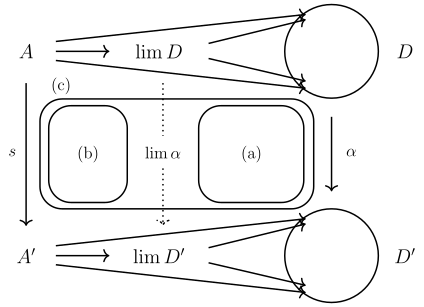
Let $\alpha$ be a natural transformation between $D, D’ : \mathbf{I} \to \mathcal{A}$. The limits of $D, D’$ induce $\lim_{\leftarrow I}\alpha : \lim_{\leftarrow I} D \to \lim_{\leftarrow I}D’$ such that,
(a) commutes
(c) commutes if (b) commutes
Limits as Adjoints
If $\mathcal{A}$ has all limits of shape $\mathbf{I}$, we can give a second reformulation:
$\lim_{\leftarrow \mathbf{I}} : [\mathbf{I}, \mathcal{A}] \to \mathcal{A}$ is the right adjoint to the diagonal functor $\Delta : \mathcal{A} \to [ \mathbf{I}, \mathcal{A} ]$.
Representables preserve Limits
For a locally small category $\mathcal{S}$ that has products and equalizers, one can construct limits for arbitrary $D: \mathbf{I} \to \mathcal{S}$ by taking the equalizer of the following:
Proof. Since $\hom_\mathcal{A}(A, D(-))$ is a functor into $\mathbf{Set}$, its limit is given by the above formula, which is the set of all families $\big(f_I : A \to D(I)\big)_{I \in \mathbf{I}}$ such that $Du \circ f_I = f_J$, which happens to coincide with $\mathrm{Cone}(A, D)$. ■
Since $\mathrm{Cone}(A, D) \cong \hom_\mathcal{A} (A, \lim D)$, we have
To dualize the result, note that $\hom_\mathcal{A}(-, A)$ is a contravariant functor from $\mathcal{A}$, and hence a covariant functor from $\mathcal{A}^{\mathrm{op}}$. Hence, $\hom_\mathcal{A}(-, A) : \mathcal{A}^{\mathrm{op}} \to \mathbf{Set}$ preserves limits in $\mathcal{A}^\mathrm{op}$, i.e.
where $D^{\rm{op}}: \mathbf{I}^{\rm{op}} \to \mathcal{A}^{\rm{op}}$. If we dualize $D^\mathrm{op}$ to $D: \mathbf{I} \to \mathcal{A}$, we have $\lim_{\leftarrow \mathbf{I}^{\rm{op}}} D^{\rm{op}} = \lim_{\rightarrow \mathbf{I}} D$.
Hence, $G(\lim D)$ represents $\mathrm{Cone}(-, G \circ D)$, i.e. $G(\lim D) \cong \lim G \circ D$. ■
Limits in Functor Categories are Pointwise-computed
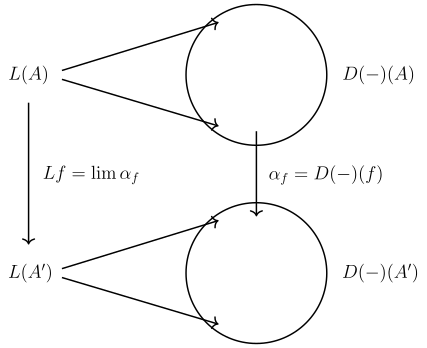
Theorem. Let $D: \mathbf{I} \to [\mathbf{A}, \mathcal{S}]$ be a diagram, and that for each $A \in \mathbf{A}$, $D(-)(A) : \mathbf{I} \to \mathcal{S}$ has a limit. Then there exists a cone on $D$ such that its image under $\mathrm{ev}_A$ is a limit cone on $D(-)(A)$ for each $A \in \mathbf{A}$. Moreover, any such cone on $D$ is a limit cone.
Proof. Follows from “Limits as Representables, varying $D$”. Refer to the following diagram.