Type-Theoretic Diagonal Argument
13 May 2026Type-Theoretic Definition of Surjectivity
Definition. For a map $f: A \to X$, we define:
\[\text{is-surj}(f) := \prod_{x: X} \| \mathrm{fib}_f(x) \|\]
The above definition expresses that “every element of the codomain has a non-empty fibre.” An equivalent definition is “the codomain equals the image.” To translate the latter definition into type theory, we define as follows:
Definition. Consider the following commutative diagram where $\iota$ is an embedding, and the commutativity is witnessed by a homotopy $H: f \sim \iota q$.
We say that $\iota$ satisfies the universal property of the image inclusion if the following holds: for any embedding $m: C \to X$, the precomposition
\[- \circ (q, H): \hom_X(\iota, m) \to \hom_X(f, m)\]is an equivalence.
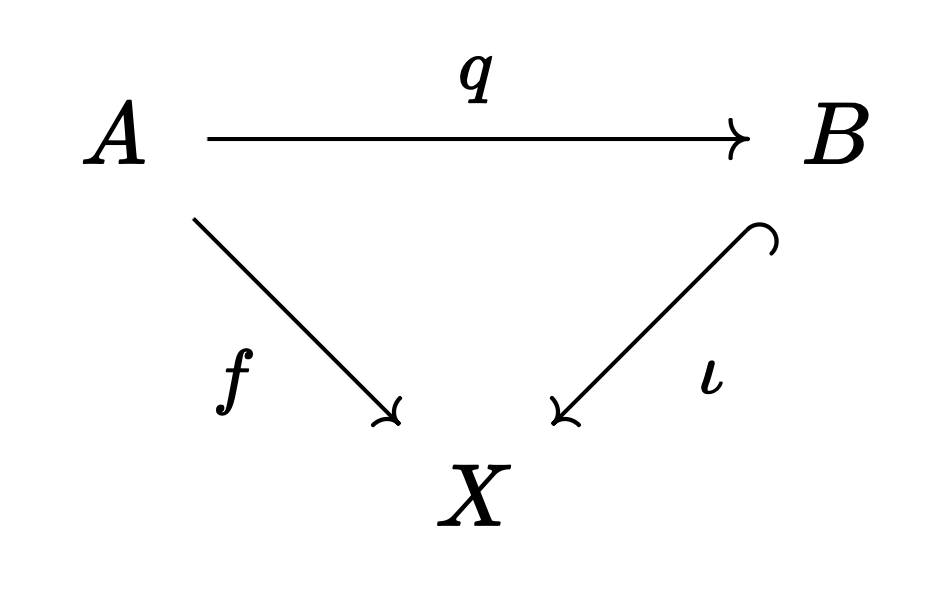
The above definition indeed satisfies the universal property of the image inclusion. That is, the following holds:
Theorem. For a map $f: A \to X$, the following holds:
\[\begin{align} &\operatorname{im} f := \sum_{x: X} \| \mathrm{fib}_f(x) \| \\ &q_f : A \to \operatorname{im} f; &&a \mapsto (f(a), |(a, \mathrm{refl}_{f(a)})) \\ &\iota_f : \operatorname{im} f \to X; &&\mathrm{pr}_1 \end{align}\]
- The following satisfies the universal property of the image inclusion:
- The embedding satisfying the universal property of the image inclusion is unique. That is, if two embeddings $i: B \to X$ and $i’: B’ \to X$ satisfy the universal property, then the type of equivalences $e: B \simeq B’$ satisfying the following commutative diagram is contractible.
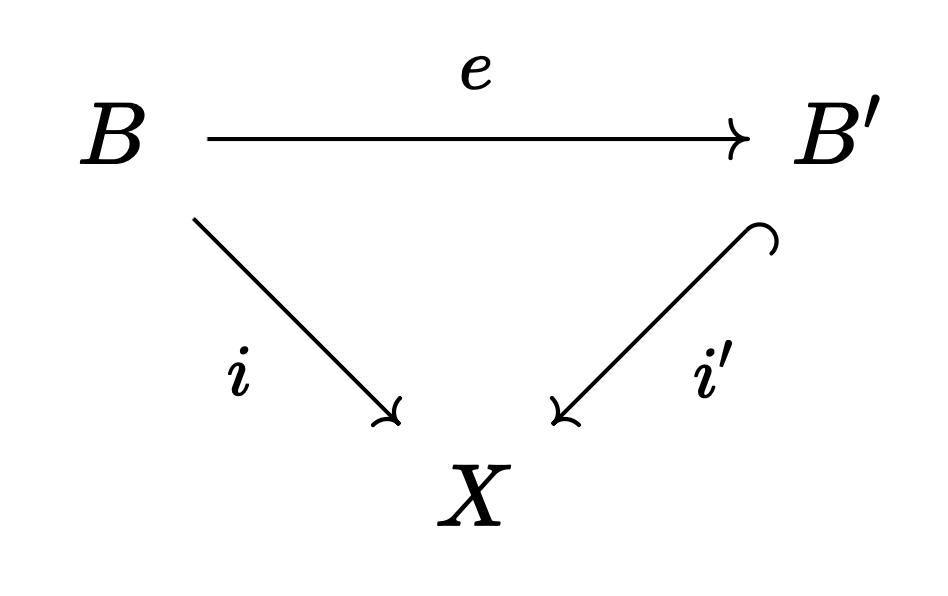
Having defined the image type-theoretically, we can now present the second definition of surjectivity.
Theorem. In the following commutative diagram, let $\iota: B \to X$ be an embedding. Then $q$ is surjective if and only if $\iota$ satisfies the universal property of the image inclusion.
Type-Theoretic Diagonal Argument
Definition. For a type $X$, we define:
\[\mathcal{P}(X) := X \to \mathsf{Prop}\]
That is, the power set of $X$ is the family of propositions over $X$. For instance, the set of even natural numbers corresponds to the proposition “is even” over the natural numbers. On the other hand, the power set of $X$ is not defined as $X \to 2$ because, in this case, the power set of $X$ would be restricted to decidable propositions.
Cantor’s Theorem. For any $f: X \to \mathcal{P}(X)$, $f$ is not surjective.
Proof. Define the following proposition $Q : X \to \mathsf{Prop}$ over $X$:
\[Q := \lambda x. \lnot f(x, x)\]If $f$ were surjective, then there would exist $g: \prod_{P: X \to \mathsf{Prop}} \| \mathrm{fib}_f(P) \|$. Hence, $g(Q) : \| \mathrm{fib}_f(Q) \|$.
Define $\mathrm{fib}_f(Q) \to \varnothing$ as follows:
\[(x, p) \mapsto \mathrm{tr}(f(x, x), p)(f(x, x))\]From the definition of propositional truncation, the above map induces $\| \mathrm{fib}_f(Q) \| \to \varnothing$. Thus, $g(Q) \to \varnothing$, which is a contradiction. Therefore, $f$ is not surjective. ■